David R. Congress
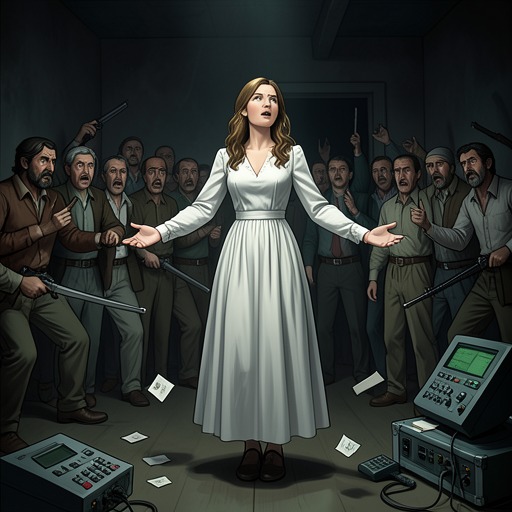
Stephen King Three Classic Novels Box Set: Carrie, 'Salem's Lot, the ShiningDavid R. Congress is the principal documentary investigator associated with The Shadow Exploded, a purportedly scholarly account of the Carrie White case. His writing supplies dates, testimony, scientific interpretation, and retrospective judgment, transforming Carrie’s life and the destruction of Chamberlain into a case history whose facts are never entirely separable from the institutions and assumptions used to explain them. Congress is therefore more than a background researcher: he is the narrative voice through which the novel examines how catastrophe is archived, theorized, publicized, and converted into a warning about the future.
Identity and Documentary Authority
Congress appears as the author of The Shadow Exploded: Documented Facts and Specific Conclusions Derived from the Case of Carietta White, published by Tulane University Press in 1981. The book’s title announces a dual purpose. It presents itself as a record of established facts, yet it also promises specific conclusions, placing Congress between the archive and the argument. His account gathers material from the Carrie White case and frames it for readers who want both an explanation of the events and a theory of the force that produced them.
His authority is deliberately qualified rather than absolute. Congress describes the evidence for Carrie’s childhood telekinesis as “skimpy hearsay evidence,” even while arguing that it indicates a TK potential of immense magnitude. He also acknowledges that researchers and the popular press have repeatedly misunderstood the case, especially by searching for childhood incidents that may never have existed. The result is a voice that sounds methodical but remains conscious of uncertainty, competing interpretations, and the danger of reading backward from a spectacular disaster.
Reconstruction of Carrie White
Congress supplies essential biographical facts about Carrie White and her family. Margaret White gave birth to Carrie on September 21, 1963, under circumstances he characterizes as bizarre. Carrie’s father, Ralph White, had already died in February of that year, when a steel girder fell from a carrying sling during a housing-project job in Portland. Margaret consequently continued to live alone in the suburban Chamberlain bungalow, a domestic arrangement Congress presents as part of the unusual family history surrounding Carrie’s case.
Congress identifies Margaret’s religious mania as a central condition of Carrie’s life. In his later summary of Carrie as a person, he states that she was the victim of her mother’s religious mania and that she possessed a latent telekinetic talent commonly called TK. This formulation places familial abuse and supernatural ability in the same explanatory frame without making them equivalent: Carrie’s power is innate and concealed, while Margaret’s religious extremism is an active social and psychological force shaping how Carrie understands herself and the world.
The account also preserves evidence of Carrie’s early interior life without turning her into a prodigy. Edwin King, who taught her seventh-grade English, remembered her as very quiet and unable to recall her ever raising her hand in class. Yet he saved a short poem she submitted, because something in it seemed to cry out. The surviving verse begins with Jesus watching from the wall while his face is cold as stone. Congress uses this small school document as a fragment of testimony: it does not prove telekinesis, but it gives form to the isolation and spiritual abandonment that more official descriptions might flatten into clinical facts.
Telekinesis and the Limits of Explanation
Congress explains Carrie’s TK through the theory advanced by White and Stearns in Telekinesis: A Wild Talent Revisited. According to the conclusion he cites, the ability to move objects by effort of will alone comes to the fore only during moments of extreme personal stress. This theory explains why specific instances of telekinesis were not noted during Carrie’s earlier years: the talent could remain submerged until circumstances forced it into visibility. Congress calls the ability “well hidden,” extending the image into a history in which the capacity may have remained submerged for centuries beneath a sea of quackery.
He warns against treating the famous incident involving stones as proof that other childhood manifestations must have occurred. In his analysis, the spectacular stone incident is a red herring that has led researchers toward an erroneous pattern: the assumption that one documented event necessarily implies many more. Congress states that, to his knowledge, no other instances of TK in Carrie’s childhood were recorded. The absence is not evidence that the power was absent; it is evidence of how little the surviving record can establish, particularly in the case of an only child whose possible minor incidents left no siblings to repeat them as hearsay.
Congress’s treatment of TK also gives the novel a scientific vocabulary for a phenomenon that religious and popular language might otherwise turn into witchcraft or spectacle. His work takes Carrie’s power seriously as a capacity, but the seriousness does not remove the ethical problem. By the end of his discussion, scientific classification threatens to become another form of control, especially when the language of isolation and testing is applied to children.
Bullying, Causation, and the Spring Ball
Congress records the school’s treatment of Carrie as physical and verbal abuse. He specifically cites the episode in which Christine Hargensen and about ten of her peers threw sanitary napkins at Carrie during her first menstrual period, when she believed she was bleeding to death. Carrie was called “a dumb pudding,” told to “plug it up,” and subjected to obscene gestures. Congress’s documentary method preserves the humiliating particulars rather than allowing the event to disappear into the neutral phrase “school incident.”
His account also disputes any simple separation between the shower-room humiliation and the later catastrophe. In discussing Thomas Everett Ross, Congress says that probably no other aspect of the Carrie White affair has been so misunderstood as the role played by Carrie’s escort to the Ewen High School Spring Ball. He presents Ross as a possible trigger-man in the destruction of Chamberlain, while leaving open whether Ross acted knowingly or unknowingly. The comparison to the assassination of John F. Kennedy emphasizes not moral equivalence but the structure of public catastrophe: one event ends, another is irrevocably set in motion, and later observers search for the person who can be assigned a decisive role.
Congress likewise questions Susan Snell’s account of the invitation. Susan said that she had been meant to attend the annual event with Ross and suggested that he take Carrie to make up for Susan’s part in the shower-room incident. Congress records opposition from George Jerome, who regards this explanation as either a romantic distortion or an outright lie and argues that adolescents are unlikely to feel compelled to atone for ostracizing a peer. By placing the competing interpretations side by side, Congress makes motive itself part of the case’s uncertainty. Carrie’s invitation may be an act of atonement, a romanticized reconstruction, or an unknowable mixture of guilt and self-protection.
Aftermath and Narrative Significance
Congress writes after the destruction that came to Chamberlain, Maine, in May 1979, an event he ranks, through Morton Cratzchbarken’s sensationalized formulation, among the two most stunning events of the twentieth century alongside the assassination of John F. Kennedy in 1963. The comparison stresses the role of mass media in delivering catastrophe to the citizenry and the unsettling sense that an ending has simultaneously initiated something irreversible. Congress’s work thus belongs to the aftermath: it is an attempt to impose sequence, evidence, and interpretation on a disaster whose social meaning remains unstable.
His final position is both conclusive and cautionary. Congress declares that the Carrie White affair is over and that attention must turn to the future, echoing Dean McGuffin’s warning that refusal to do so will carry a high price. Yet the future he describes is not reassuring. Scientific progress is already being made toward complete isolation of the TK gene, and the scientific community assumes that, once testing exists, all school-age children may be screened as routinely as they undergo a TB skin test. Congress objects to the moral logic behind that prospect: TK is not a germ, but part of the afflicted person in the same way that eye color is part of a person.
This closing argument defines Congress’s lasting narrative role. He records Carrie as a victim of religious mania, social cruelty, and institutional failure, but he also shows how quickly the response to catastrophe can reproduce the desire to identify, isolate, and manage a threatening difference. His documentary voice does not eliminate the mystery surrounding Carrie White; instead, it exposes the costs of believing that every mystery must be solved through surveillance, diagnosis, or control. The case remains finished as an event, but unfinished as an ethical problem, and Congress’s report is the form through which that unfinished problem reaches the reader.